
- Cats are wired to hunt small, quick, unpredictable prey
- Stop, start, hide and escape movements trigger the chase
- Always let the hunt end with a real catch
Few things are as reliable as a cat and a piece of string. Drag it slowly across the floor and even a sleepy senior cat will often lift their head, widen their eyes and start to track it. Switch on a laser pointer and the effect is even stronger. To understand why, it helps to think about what cats are built to do.
Cats are hunters first
Domestic cats share almost all of their behaviour with their wild ancestors. A free-roaming cat may make many small hunting attempts in a day, most of them for tiny prey like mice, insects and lizards. Each hunt is short, fast and full of stop-start movement. That is why the hunting drive is not something a cat switches on only when hungry. It is part of how a cat experiences the world and indoor cats carry the same drive even when their food bowl is always full.
The hunting sequence usually follows the same pattern: watch, stalk, chase, pounce, catch and kill, followed by eating and grooming. Toys that let a cat move through this whole sequence tend to leave them calm and content afterwards. Toys that only allow part of it can leave them restless.
Why strings are irresistible
A string moving across the floor looks a lot like the tail of a mouse or a slithering lizard. It changes direction suddenly, it disappears behind furniture and it twitches when it stops. Cats are especially sensitive to movement that goes away from them or across their line of sight, because that is what fleeing prey does. A string coming straight at a cat is much less interesting than one sneaking past.
Strings also give the cat something real to grab. When the pounce lands, the cat feels the string under their paws and can bite it, which completes the hunting sequence. That is a big part of why wand toys with feathers or ribbons are so popular with behaviour experts.
Why laser dots are so exciting
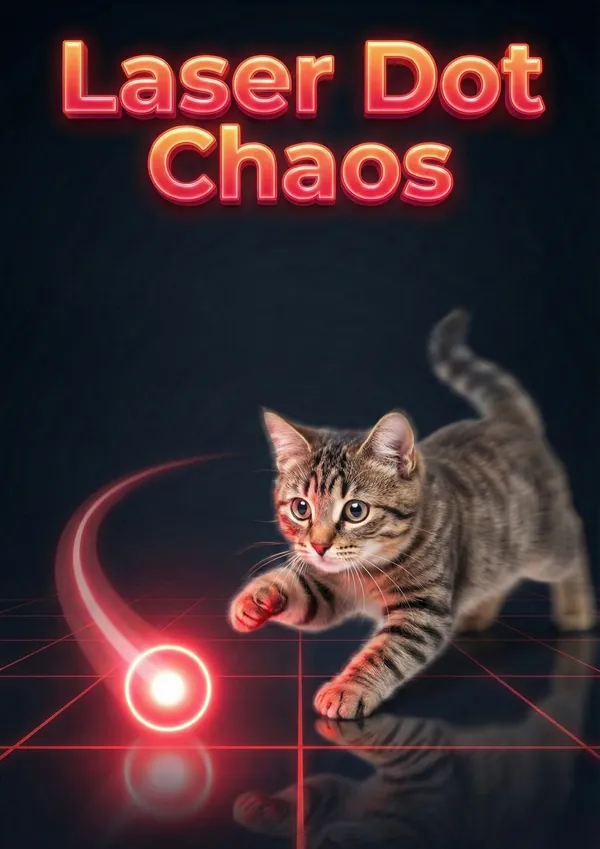
A laser dot is pure movement. It is bright, fast and can change direction faster than any real prey, which makes it incredibly stimulating. Cats see motion extremely well, especially in low light, so a dot gliding across a dim room is hard to ignore.
The challenge is that a laser dot can never be caught. The cat watches, stalks, chases and pounces, but the moment of capture never arrives. Some cats handle this fine, while others become frustrated, keep searching for the dot after it disappears or start chasing reflections and shadows. The solution is easy: always finish a laser session by guiding the dot onto a real toy the cat can grab or toss a treat or a kicker toy as the final "catch".
Movement patterns that trigger the chase
Whether it is a toy on a string or a target on a screen, certain movements work better than others:
- Stop and start: prey freezes when it senses danger. Pauses build anticipation and give the cat time to wiggle and plan the pounce.
- Moving away or across: movement that crosses the cat's view or retreats invites a chase.
- Hiding: disappearing behind something and peeking back out is irresistible.
- Small twitches: tiny movements while "frozen" keep attention locked on.
- Escaping when touched: real prey tries to flee and that burst of speed sparks another round.
These are exactly the behaviours we built into our Play Videos, where strings curl, laser dots dart, objects hide off-screen and escape when your cat taps near them. Our tap games use the same idea with roaches, fish, lizards and feathers.
What chasing does for your cat
Chase play is more than fun. It gives indoor cats a chance to use their bodies and their brains in the way nature intended. Owners often notice that a cat who has had a good play session is calmer in the evening, less likely to pounce on ankles and more likely to settle for a long nap. Short daily sessions can also help less active cats stay in good shape, alongside guidance from your vet.
Play is also a bonding activity. When you move the toy, you become part of the game. Many shy cats grow in confidence through gentle play with a trusted human.
Making chase play satisfying
- Let them win. Allow a successful catch every few pounces so your cat feels like a skilled hunter.
- Keep it short. A few short bursts of play are often better than one long session. Our guide on how long cats should play each day goes into detail.
- Finish with a real catch. End laser and screen games with a physical toy or a treat.
- Follow with food. Playing before a meal mirrors the natural hunt, eat, groom and sleep rhythm.
- Rotate toys. Novelty matters. Swap toys and games around so nothing gets stale.
Choosing colours your cat can see
Cats do not see colour the way we do. Red can look dull and brownish to them, while blues and yellows stand out more clearly. That is why many cat toys and on-screen games lean on those colours and on strong contrast. Our guide to the colours cats see best explains feline vision in plain language.
The bottom line
Cats chase strings and laser dots because they are wired to hunt small, quick, unpredictable prey. You cannot switch that drive off and you would not want to. By offering movement that looks like real prey and always letting the hunt end with a catch, you give your indoor cat a healthy outlet that leaves them happy and relaxed. Whether you use a feather wand, a laser pointer or a screen game, the key ingredients are the same: interesting movement, a sense of success and plenty of love afterwards.

Ready to play? 🐾
Download Cat Paw Games free on Google Play and start with two games, the daily streak and a fun cat video.
GET IT ONGoogle Play